Architecture
Constitutional AIOps has four parts: a dual-agent LLM pipeline, a constitutional safety framework, an optional graph-episodic memory, and human-in-the-loop approval.
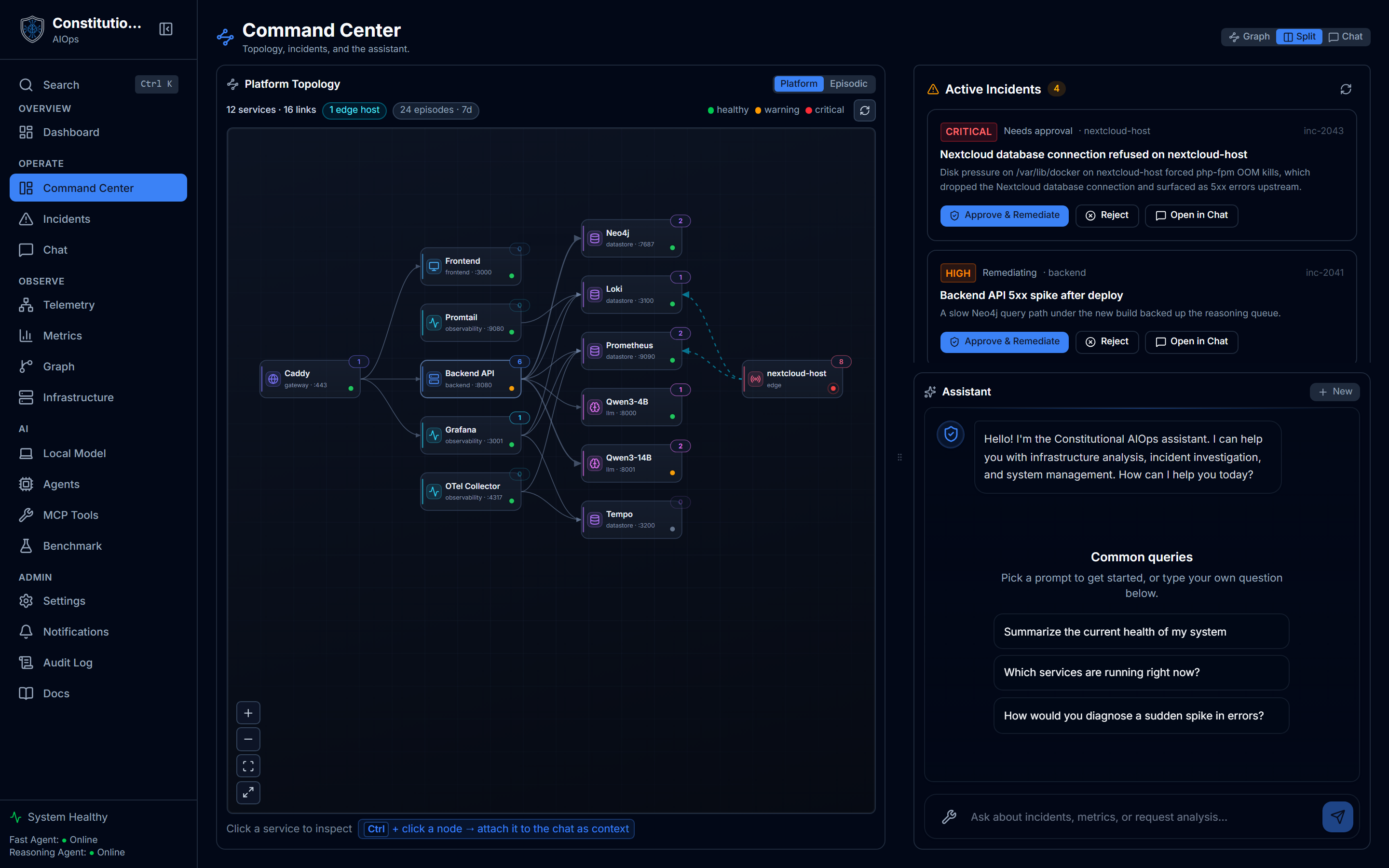
The topology graph above is rendered by Console. The same graph structure, with episodes and root causes layered on top, is what Graph Explorer visualizes in full.
Full screenshot walkthrough
This page explains how the pieces fit together. For every screen with its own tutorial, start at Features and tutorials.
Dual-agent pipeline
Two logical agents split the work by latency and depth:
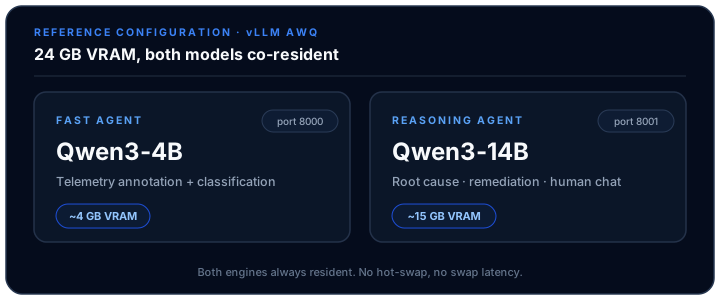
- Fast agent. Annotates and classifies incoming telemetry (logs, metrics, traces). It is optimized for high volume and low latency.
- Reasoning agent. Handles root cause analysis, remediation planning, and the human chat. It runs on a larger model when you have one.
Both agents speak to any OpenAI-compatible endpoint. They can share one endpoint and model for a minimal setup, or use two for the reference configuration. See Bring Your Own Endpoint.
Reference configuration
The research-paper reference runs both models co-resident on a single 24 GB GPU with vLLM. This is not a requirement for self-hosting, which is why the lite profile offloads the LLM to a remote endpoint instead.
Graph-episodic memory
An optional Neo4j store keeps past incidents as episodes and links them into a graph, so the reasoning agent can retrieve similar past incidents and their successful actions. Retrieval is hybrid: vector similarity plus graph structure.
The backend is pluggable through AIOPS_GRAPH_BACKEND. The full stack uses Neo4j. The lite profile defaults to an embedded SQLite store that persists to disk with no Neo4j server, so the Graph page keeps its memory across restarts. A memory option gives an ephemeral store for tests. See Configuration.
Human-in-the-loop
Action tools never execute inside the model loop. A proposed action is scored by the constitutional validator, then routed by the authorization matrix. Depending on confidence it runs automatically with an audit record, waits for a human approve or reject decision, or only raises an alert. See Constitutional Safety for the full model.
Technology stack
| Component | Technology |
|---|---|
| LLM hosting | Bring your own (vLLM, Ollama, AWS Bedrock, OpenAI) |
| LLM runtime | Any OpenAI-compatible endpoint |
| Graph memory | Neo4j 5.x, or an embedded SQLite store (AIOPS_GRAPH_BACKEND) |
| Observability | Grafana, Loki, Tempo, Prometheus (full stack) |
| Backend | FastAPI (Python 3.11+) |
| Frontend | React 19 + TypeScript + Tailwind |
| Container | Docker Compose |