Developer Platform
Constitutional AIOps is built to be scripted and extended, not just clicked. This page describes the developer surface: what you can use today, and what is on the near-term roadmap. Anything not yet shipped is labeled as such, so nothing here is a promise you cannot check against the code.
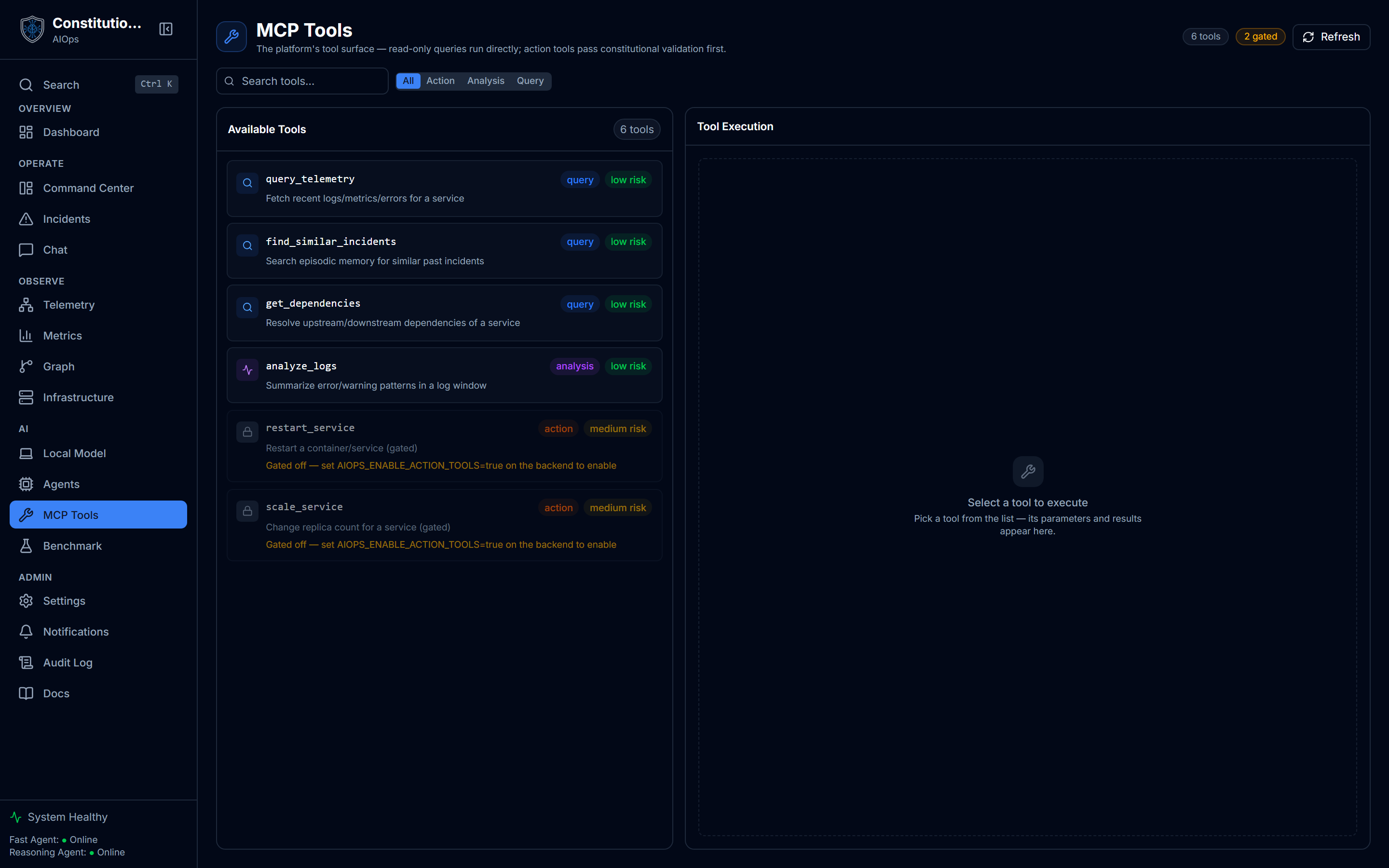
The tool registry described below is the same one MCP tools exposes directly: every tool, its parameters, and a way to run one yourself and read the result. Agent Hub shows the two agents that call these tools day to day.
Available today
The REST API
Every screen in the app is a thin client over a documented REST API under /api/v1. Incidents, actions, tools, telemetry, the knowledge graph, benchmark runs and settings are all reachable programmatically.
When the backend is started with docs enabled (AIOPS_ENABLE_DOCS=true, or any non-production build), the interactive reference is served at:
- Swagger UI at
/docs - ReDoc at
/redoc - The raw OpenAPI schema at
/openapi.json
List endpoints share one envelope, so pagination is uniform:
{ "items": [ ... ], "total": 128, "page": 1, "page_size": 50, "has_more": true }Custom system prompts
Each agent's system prompt can be overridden through the /api/v1/prompts routes (admin-gated). This is the supported way to steer the reasoning and fast agents without touching code.
Bring your own tools, today, in a fork
The tool registry that powers chat and remediation is code-defined. If you run your own build you can add a tool by editing the registry. A packaged plugin path that does this without forking is available today; see Extensions below.
Client SDKs
Official clients live in the repository under sdk/:
- Python,
sdk/python: packageconstitutional-aiops. - TypeScript,
sdk/typescript: package@constitutional-aiops/sdk.
Both are published (0.3.0, live on PyPI and npm), hand-written, and dependency-free today. The ergonomic client covers the high-value tags directly: incidents, actions (each still passing the constitutional gate), agents, the episodic graph, audit, notifications, benchmark, metrics, chat (streaming and non-streaming), and self-service personal access tokens; 0.3.0 adds the generative-UI insight widgets (explain + preferences), the MCP tool registry (tools/get_tool/call_tool), and chat decisions, plus automatic pagination and opt-in retries. The full 127-path surface stays available through the generated typed core.
The SDK Reference documents every method, its parameters, return shape and errors; the SDK Cookbook has task-shaped recipes. Each package README also lists every method; see sdk/CHANGELOG.md. Example, Python:
from constitutional_aiops import AIOpsClient

client = AIOpsClient("https://your-instance.example.com", token="aiops_pat_...")
for incident in client.paginate("/incidents/", severity="critical"):
    print(incident["id"], incident["title"])
TypeScript:
import { AIOpsClient } from '@constitutional-aiops/sdk'

const client = new AIOpsClient({ baseUrl: 'https://your-instance.example.com', token: 'aiops_pat_...' })
for await (const incident of client.paginate('/incidents/', { severity: 'critical' })) {
  console.log(incident.id, incident.title)
}
Each package also ships a generated typed core (from the committed OpenAPI schema) alongside this hand-written ergonomic layer. The packages publish to PyPI (constitutional-aiops) and npm (@constitutional-aiops/sdk) on a pushed sdk-v* tag.
Authentication for scripts
Today the API accepts the session cookie the UI uses, and against an instance with AUTH_REQUIRED unset (the default single-user mode) no credential is needed.
Personal access tokens. A per-user token you create, list and revoke in the app (Settings, or POST /api/v1/auth/tokens), sent as Authorization: Bearer aiops_pat_..., hashed at rest and scoped to your own role. This is the clean path for CI and scripts, and it resolves to your user even when AUTH_REQUIRED is off, so calls stay attributed and cost-fenced.
Extensions
Custom tools via plugins are available today, off by default. Third-party packages contribute tools through a Python entry point group (constitutional_aiops.tools), loaded at startup only when AIOPS_ENABLE_PLUGINS is set on the backend; with it unset the plugin surface does not exist. A plugin tool is registered into the same catalogue, listing and dispatch as the built-in tools and runs through the identical constitutional gate (kill-switch, validator, human approval, audit). A plugin cannot supply its own gate, cannot shadow a built-in tool name, and any action that changes infrastructure requires human approval. A malformed plugin is logged and skipped rather than breaking the tool surface. See MCP tools for the full contract.
A plugin tool returns a small, stable result shape that the chat UI renders, so it gets a usable surface without shipping frontend code.
Custom agents and custom React widgets are not runtime-pluggable and are not presented as if they were. The supported extension path is custom prompts plus custom tools. Pluggable agents remain a future major-version item.
The safety contract
Everything the SDK or a future plugin does still runs through the constitutional layer. An action that the validator blocks, or that needs human approval, comes back as a refusal with the gate's own verdict, not as a silent success. Both SDKs surface this as a ConstitutionalRefusal. See Constitutional Safety.